
Introduction: The Silent Profit Killer in Ocean Freight
Every year, footwear brands and third-party factories lose millions of dollars to a problem that rarely appears on the production line—ocean freight mold. A container that leaves a dry port in Asia can cross the equator, pass through tropical humidity belts, and arrive in a cold European or North American warehouse within four to six weeks. During that journey, physics works against your product in ways that spreadsheets do not always capture.
The most destructive phenomenon is container rain—also called cargo sweat or container rain condensation. When warm, moisture-laden air inside a sealed steel box contacts the cold steel walls of the container (often during night-time temperature drops at sea or upon arrival in a cooler climate), water droplets form and run down the walls. That water re-evaporates, raises relative humidity inside the box, and penetrates cartons. By the time cartons reach individual shoe box humidity levels above 75% RH, mold spores that were dormant at the factory can germinate within days.
For quality assurance (QA) managers and procurement leaders, the business impact is brutal: full-carton write-offs, emergency rework, delayed retail launches, and brand-damaging customer complaints—especially on premium materials such as suede shoes and full-grain leather, which act like sponges in humid micro-environments. The challenge is not merely “keeping boxes dry.” It is engineering an active, compliant micro-climate inside every shoe box for the entire transit window. That is the standard global brands now expect from every Nominated Supplier in their footwear programs.
Why Traditional Desiccants Fail in Closed Shoe Boxes
The Closed-Loop Micro-Environment Problem
Mineral clay desiccants and silica gel packets are passive tools. They absorb free water vapor until their adsorption capacity is saturated. Inside a sealed shoe box—often further sealed inside a polybag—the total air volume is small. Industry field data and third-party logistics audits consistently show that standard desiccant units sized for “one shoe box” can reach equilibrium saturation within the first third of a typical 30–45 day ocean transit when:
- Upstream cartons absorbed moisture during export warehouse staging in monsoon season;
- Leather uppers retained manufacturing humidity above equilibrium;
- Container rain elevated in-carton RH before individual boxes were even opened at destination.
Once saturated, a desiccant becomes dead weight. It no longer lowers RH. Worse, it can give planners a false sense of security on the packing line—workers see a packet in the box and assume the job is done.
Why Suede and Premium Leather Are the First Casualties
Suede shoes mold faster than coated leather for three material-science reasons. First, napped fibers increase surface area and capillary retention. Second, suede is often less heavily sealed with synthetic finishes, leaving hygroscopic cellulose and protein structures exposed. Third, luxury product lines frequently omit aggressive fungicidal topcoats for aesthetic and chemical-safety reasons—shifting the burden of protection entirely to packaging.
Passive drying cannot reverse moisture already bound inside the material. Desiccants only address vapor in the air gap. When the air gap is tiny and the material is hungry for water, RH equilibrates quickly—and mold follows.
Operational Data Points QA Teams Should Track
- Time-to-saturation: Log when desiccant color indicators (if used) change; correlate with sailing schedule.
- Box RH at pack-out: Spot-check with calibrated hygrometers at the end of the packing line—not only at warehouse level.
- Claim rate by lane: Compare EU winter arrival vs. Southeast Asia summer export; container rain severity varies by trade lane.
Brands that only audit factory humidity without simulating in-box conditions during transit are auditing the wrong system.
The Science of Active Vapor-Phase Protection
From Passive Absorption to Active Atmosphere Control
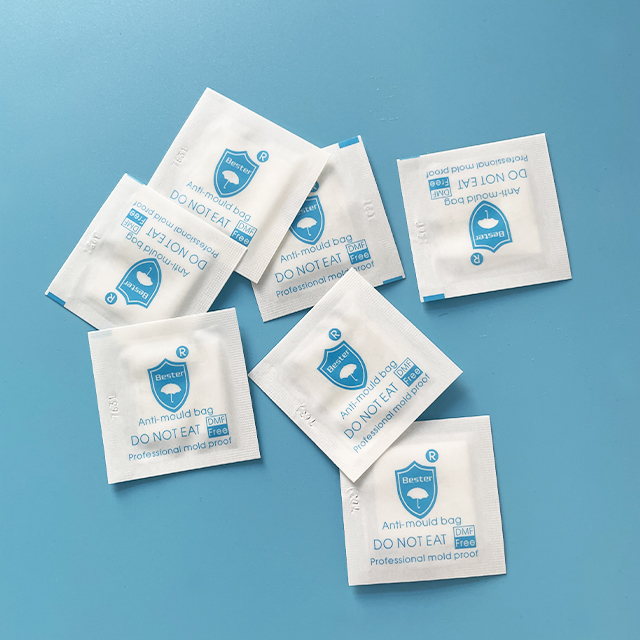
Vapor-phase anti-mold technology represents a category shift. Instead of trying to remove every molecule of water from a sealed box, an engineered chip sublimates trace concentrations of anti-mold essential-oil actives into the headspace. These actives distribute through the box atmosphere by diffusion and convection—reaching corners, tongue areas, and tissue paper wraps that desiccants never touch.
The mechanism targets the root biological driver: mold spores are ubiquitous. They do not “appear from nowhere” at port. They are present at low levels in factory air, on cartons, and on materials. What triggers visible growth is sustained RH combined with temperature cycles. Vapor-phase actives interfere with spore metabolism and proliferation in that headspace, maintaining a biologically hostile micro-environment for the full voyage.
360-Degree Coverage Without Contact Staining
Contact-based fungicidal strips risk leaving marks on light-colored suedes or unfinished leather edges. Gas-phase delivery avoids direct contact with the upper while still achieving comprehensive coverage—critical for QA sign-off on appearance-sensitive SKUs.
For supply chain engineers, the practical implication is clear: one correctly placed chip per box can protect not only the shoe but also ancillary materials—tissue, heel cushions, and RFID tags—that would otherwise harbor secondary mold colonies.
Alignment with Long-Haul Ocean Freight Reality
Vapor-phase systems are designed for the duration curve of ocean freight mold risk—weeks, not hours. Controlled-release formulations avoid the “front-loaded protection / back-end exposure” failure mode common with undersized desiccant packets. That is why leading footwear programs are migrating from commodity drying packets to specified vapor-phase anti-mold chips in packing SOPs.
Compliance and Global Brand Standards
Chemical Safety Is No Longer Optional
Global brand owners treat footwear packaging chemicals with the same rigor as upper finishes. A mold-prevention product that performs well biologically but fails a restricted-substance screen can disqualify a factory from millions of units of allocation overnight.
Programs that qualify as a Nominated Supplier must demonstrate:
- Full REACH compliant documentation—specifically screening against the EU SVHC candidate list (231+ substances in current brand audit playbooks);
- Absence of banned fungicides such as dimethyl fumarate (DMF) above detection limits;
- Alignment with U.S. and EU consumer-product chemical safety expectations for articles in prolonged enclosed storage.
Third-party factories should not treat compliance PDFs as shelf art. QA auditors increasingly request lot-traceable certificates tied to the exact SKU packed on the line that week.
Transportation and Non-Hazardous Classification
Another hidden cost of non-compliant or poorly documented anti-mold chemistries is logistics friction—DG declarations, rejected bookings, and air-freight surcharges. Professional-grade footwear anti-mold chips engineered for export markets are validated for non-restricted status under common IATA/IMDG frameworks when used as directed, reducing customs and carrier queries compared to legacy industrial fungicides.
Building an Audit-Ready Dossier
QA leaders should maintain a single digital dossier per nominated program: REACH/SGS reports, MSDS, usage SOP, dosage matrix by shoe category, and claim-history log by destination market. Brands reward suppliers who make audits boring—because boring means zero surprises at receiving inspection.
Selection Guide: Bester 505 vs. Bester 303
Not every SKU faces the same mold risk profile. Packing-line economics and material sensitivity should drive specification—not habit.
Deploy Bester 505 When Risk Is Maximum
For premium programs, large-volume shoe boxes, heavy-oil leathers, thick suede uppers, or extended ocean freight lanes through high-humidity trade corridors, specify Bester 505 High-Efficiency Anti-Mold Chip. The 505 platform delivers higher essential-oil loading and a full-size chip format engineered for maximum headspace activity over multi-month protection windows—exactly the scenario where container rain and shoe box humidity spikes are most dangerous.
Deploy Bester 303 When Precision and Cost Control Matter
For compact cartons, children’s sizing, lighter synthetic uppers, or programs with moderate mold history, Bester 303 Eco-Efficiency Anti-Mold Chip applies the same core vapor-phase anti-mold mechanism as 505 with optimized dosage and footprint. Remember: 303 is not a desiccant—it does not absorb moisture. It is the precision-dosed sibling for factories that must hit brand mold standards while controlling total packaging spend.
Quick Comparison for Procurement
- Mechanism: Both 505 and 303 = vapor-phase gas release (active).
- Best for suede / premium leather: 505 default; escalate from 303 only after technical sign-off.
- Best for compact boxes / cost-sensitive lines: 303 primary; 505 for high-risk SKUs within the same factory.
- Compliance: Both platforms documented for REACH compliant nominated programs.
Call to Action: Audit Your Lane Before the Next Booking
If your team is still relying on commodity silica gel while filing mold claims at destination, the data is telling you the strategy—not the factory—is misaligned. The footwear brands winning the post-pandemic quality war are specifying active, documented, REACH compliant vapor-phase protection at the SKU level.
Request Free Samples & Get a Professional Anti-Mold SOP Audit for Your Supply Chain—our technical team will review your trade lane, box geometry, and material mix, and recommend a 505/303 deployment map you can present directly to your brand QA counterpart.
Do not wait for the next container rain season to become another write-off report. Engineer the micro-environment inside every box—before the container door closes.