

Short answer: Contact stickers protect a local patch; vapor-phase chips and bags treat the sealed box air. For footwear export, choose chip or bag by volume and risk — not a sticker alone.
Three Forms of Anti Mold Protection
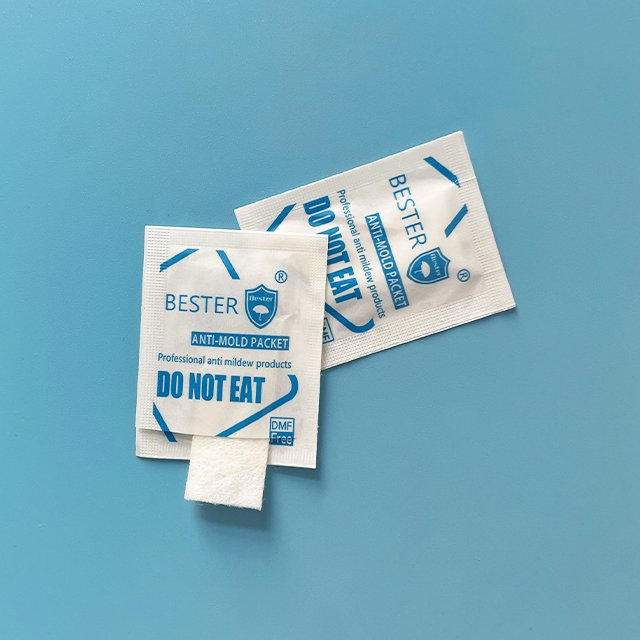
Chip: A compact vapor-phase piece placed in the shoe box—Bester A505 is the upgraded chip format for export lines.
Sticker: An adhesive patch on the box wall or near the product. Many ordinary stickers are contact-limited.
Bag / pouch: A soft vapor-phase pack—Bester C304—easy for high-volume packing training.
How Each Works: Contact vs Vapor-Phase Technology
| Technology | Mechanism | Coverage | Typical form |
|---|---|---|---|
| Contact-only | Active near the touch surface | Local area | Ordinary sticker |
| Vapor-phase | Active vapor fills sealed space | Whole micro-pack | Chip / bag |
The decisive difference: vapor-phase products can reach soles, tongues, linings, and hardware inside a sealed box. Contact stickers cannot match that coverage unless the entire surface is plastered—which factories will not do.
Comparison Table
| Dimension | Anti Mold Chip | Anti Mold Sticker | Anti Mold Bag |
|---|---|---|---|
| Technology | Vapor-phase | Often contact-limited | Vapor-phase |
| Coverage | Full sealed volume | Local | Full sealed volume |
| Duration (typical) | 3–6 months | 1–3 months | 6–12 months |
| Best use | Premium shoe boxes | Small local patches | Boxes, cartons, pallets |
| Line ease | Drop-in | Peel & stick | Drop-in |
| Bester model | anti mold chip A505 | — | anti mold bag C304 |
Why Vapor-Phase Bags Outperform Contact-Only Stickers

- Full coverage inside sealed boxes, including hidden surfaces.
- Longer release profiles in pouch designs for long storage + ocean legs.
- Position flexibility—no need to hit one exact wall spot.
- Cleaner cosmetics—no sticker residue on retail-facing surfaces.
For packing SOPs, follow how to use anti mold bags. For model selection between upgraded chip and standard bag, see the A505 vs C304 comparison.
Recommendation by Scenario
| Scenario | Recommendation | Why |
|---|---|---|
| Shoe box packing | C304 bag or A505 chip | Vapor-phase full coverage |
| Export carton | C304 bag | Flexible dosage |
| Warehouse pallet | C304 + container poles on export | Dual layer |
| Shipping container | Container desiccant poles (303) | Container-scale moisture |
| Tiny local touch-up | Sticker (if specified) | Lowest coverage / lowest cost |
Bester positions A505 as a stronger vapor-phase chip versus ordinary stickers—not as a denial of chip technology. Choose the form that matches brand tier and line speed, then validate with sealed-box trials.
How Buyers Should Trial Forms on the Line
Run a controlled trial: same style, same packing day, sealed boxes with ordinary sticker vs A505 chip vs C304 bag. Store matched sets in a humidity cabinet or a humid warehouse corner for 2–4 weeks, then open and score visible mold, odor, and cosmetic marks. Share photos with the brand QA team before changing the annual packing BOM.
Do not judge forms only by unit price. A cheaper contact sticker that fails on 2% of pairs can cost more than upgrading the whole lot to vapor-phase protection. Also avoid messaging that “chips are useless”—Bester’s A505 is a vapor-phase chip positioned as stronger than ordinary stickers for sealed export boxes.
When Stickers Still Appear in Specs
Some legacy customer specs still say “anti mold sticker.” Translate that requirement into performance language: sealed-box mold suppression for the voyage + warehouse dwell. Propose A505 or C304 as the compliant upgrade path, with REACH/DMF-free files attached. Keep silica gel discussions separate unless the customer explicitly requires a moisture absorber SKU.
Communication Guide for Brand Merchants
Merchants often search “anti mold sticker” even when they need vapor-phase performance. In RFQs, mirror their language in the title line, then specify mechanism: vapor-phase chip or bag for sealed footwear export packaging, REACH-oriented and DMF-free documentation available. Attach the comparison table from this article so sourcing committees can vote with the same facts.
Factory owners should avoid swinging between extremes—either cheap stickers with high claim rates, or over-specifying industrial machines for problems that start in the shoe box. Most mold claims on finished pairs are micro-environment failures. Fix the box first, then the warehouse, then the container.
If you already use A505 chips on upgraded lines, keep them. The goal is not to replace chips with bags universally; it is to stop under-performing contact-only stickers where sealed-box coverage is required. C304 bags remain the high-volume workhorse when line training favors a pouch format.
Documentation Pack for Each Form
Maintain separate SDS, REACH, and DMF-free files for chip and bag SKUs. Auditors dislike one PDF reused for every format. Label retain samples by form and lot. When a claim arrives, you can show exactly which form was packed into the complained style.
Procurement tip: put “vapor-phase required for sealed footwear export packaging” into the packaging specification so factories cannot silently revert to contact-only stickers to save cents. Review first production cartons with photos. If a factory still uses ordinary stickers on upgraded lines, escalate with trial data rather than opinion.
Pair this comparison with the A505 vs C304 model guide when you need to choose between upgraded chip and standard bag after you have already rejected contact-only stickers.
Operational note: keep chip and bag SKUs in separate bins on the packing line with color labels. Mixing A505 and C304 is fine by design, but packing the wrong form against a brand BOM creates audit noise. Scan or tick the packaging BOM at carton close when the customer requires traceability photos.
For factories & exporters
Home mold cleaning is not the same as export packing mold control. If you run a shoe factory or brand program, use vapor-phase anti-mold inserts (not silica gel alone) before sealing boxes.
Anti mould bag hub · A505 chip · C304 bag · A505 vs C304 trial · Why silica fails · Buyer FAQ ·